
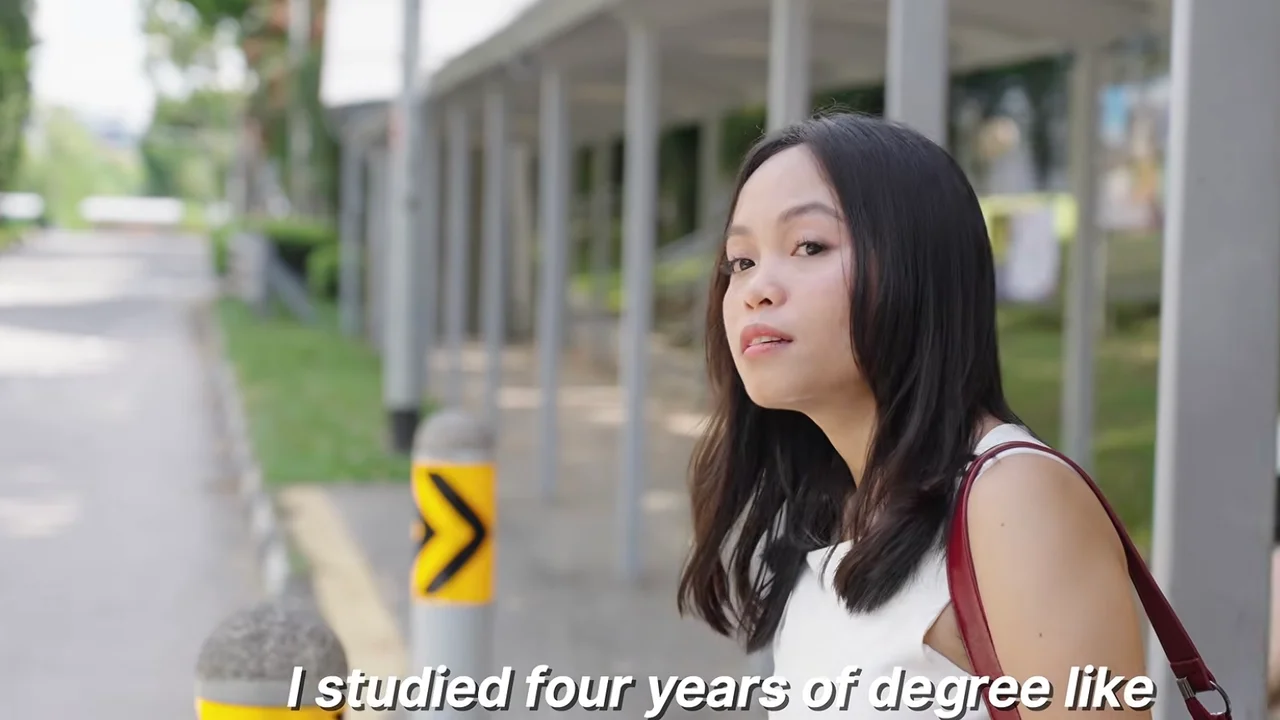
Filipina university graduate explains why she works as a helper in Singapore
SINGAPORE: A recent video from Mediacorp’s YES 933 provided quite the revealing look into the life of a domestic migrant worker in Singapore, showing that in some economies at least, a university education is not a guarantee of a white-collar job.
In the programme, host Jia Hui spent a day with Clergy, a Gen Z Filipina who, after getting a university education in the Philippines, now works as a helper in Singapore.
Once upon a time, Clergy, who has a Bachelor of Science degree in Hospitality Management, dreamt of working on a cruise line because she wanted to travel the world. Unfortunately, due to the height requirement, the petite Filipina was rejected for this type of job.
She added that her family did not have the necessary finances for all the paperwork for applying, and therefore she settled for an office job, but it paid such a low salary that she could not support herself.
Clergy’s next step was to move to a big city and apply for a call centre job, but she was met with rejection upon rejection.
Finally, she decided to apply to be a domestic helper in Singapore, as this did not require her to shell out any money. What helped her decide was the pay. Clergy told Jia Hui that her office job back home paid her less than S$300, and now she earns double that amount, sometimes even more.
Half of what she earns, she used to send home to help with her younger siblings’ needs. But now that her stepmother, who is also a migrant domestic worker, supports the family, Clergy is able to happily spend on herself—going to concerts and F1 events, among other ways of treating herself.
Filipina helpers
Clergy is just one among as many as one million Filipinas working in other countries as domestic helpers. A significant portion of around 2.19 million Filipinos are working overseas as maids.
Filipino women have been cooking, cleaning and caregiving for families other than their own for around half a century, starting in the 1970s as a temporary fix for unemployment when the country was undergoing economic hardships under the rule of President Ferdinand Marcos, the father of the current president.
Unfortunately, the situation has not changed for many Filipinos since then, and until now, having a family member work overseas, whether it’s in a professional capacity, as a seaman, or as a maid, can mean having more nutritious meals on the table, a roof overhead, or schooling in the hopes of escaping from poverty.
While the salary for helpers elsewhere, such as the United Arab Emirates, may be higher, Singapore is a preferred destination for many Filipina helpers, in large part due to good wages in comparison to what they would earn in similar jobs back home, easier communication, and legal protection and strict regulation under the Manpower Ministry.
Life in Singapore
Working as a helper is arguably no one’s dream job, but in Singapore, it’s better than what Clergy had back home, and the resilient young woman has learned to adjust her dreams.
Clergy’s stepmum’s sister, with whom she appears to have a close relationship, also works in Singapore, which means there’s a nearby support system and someone to spend time with on her days off. Not that it hasn’t been challenging. Like practically everyone else in the Filipino diaspora, Clergy and her step-aunt have had to deal with homesickness and loneliness.
Clergy’s first three months were the hardest.
“I kept asking myself, why did I study so hard just to become a helper like this? And I’d say, ‘Lord, where is my plot twist?’ Eventually I realized it was okay… your ego will not feed your stomach,” she told Jia Hui.
Newsletter
Get updates straight to your inbox
In Singapore, she has learned to enjoy life and buy what she wants.
“It’s not about the job title. It’s about how they pay you more than what you earned back in the Philippines,” Clergy added.
“It’s legal work. It’s clean money. It’s motivation for us,” her step-aunt added.
The young Filipina is also fortunate in having kind employers, to whom she is thankful, as they treat her like she’s part of the family.
She admitted, however, that her college friends don’t know about her work in Singapore, implying that, as a university graduate, this isn’t something she’s completely proud of.
The most heart-wrenching part of the video comes at the end, when Clergy video calls her father, who raised her after her parents separated when she was a small child. Perhaps, after years of his caring for her, she rejoices that she can somehow pay back, asking him if he still has his “allowance.”
When he says no, Clergy asks if he would like her to send money.
When he says yes, she asks, “How much do you want?”
“Just a small amount,” he answers.
Watch the full video here. /TISG
Read also: Helper thanks ‘beloved’ Singapore employers who surprised her with gifts and a cake on her birthday